Hurson: A Handwritten Display Font with Vintage Soul
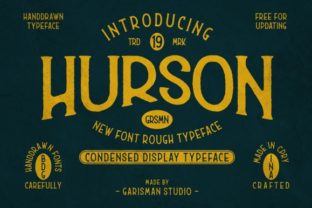
Hurson isn’t just another script font—it’s an original handwritten display typeface crafted with intention. Every curve, taper, and subtle irregularity was drawn by hand, then carefully digitized to preserve its organic rhythm and quiet confidence. It carries a classic feel without leaning into nostalgia for its own sake. That balance—timeless but not dated, personal but not overly casual—is what makes Hurson especially useful for creators who want authenticity without sacrificing clarity or impact.
Why Hurson Stands Out in a Sea of Scripts
Most handwritten fonts fall into one of two camps: ultra-loose and playful (great for kids’ brands or whimsical blogs) or tightly refined and elegant (ideal for luxury packaging or formal invitations). Hurson lives comfortably in the middle. Its letterforms have gentle contrast, natural entry and exit strokes, and consistent—but never mechanical—spacing. There’s warmth in the lowercase a, authority in the uppercase H, and readability even at smaller display sizes.
Unlike many “hand-drawn” fonts that rely on random alternates or heavy texture overlays, Hurson achieves character through deliberate design choices: slightly uneven baselines, soft terminals, and a subtle forward lean that suggests motion—not haste. That means it works where other scripts fail: on signage, apparel tags, digital banners, and editorial headers where legibility and tone must coexist.
Creative Applications That Feel Real, Not Forced
Hurson shines when it supports a message—not overshadows it. Here’s how different users bring it to life:
- Small business owners use Hurson for café chalkboard menus, bakery packaging, and local event posters—pairing it with a clean sans-serif (like Inter or Montserrat) for body text keeps communication grounded and scannable.
- Freelance designers apply Hurson to brand identities for makers, artisans, and independent bookshops—its authenticity signals care and craft without needing illustration or extra graphic elements.
- Educators and workshop facilitators integrate Hurson into slide decks and handouts for creative courses; students respond to its approachability, and it subtly reinforces the value of handmade thinking.
- Bloggers and content creators deploy Hurson in featured post headers or newsletter banners—especially for topics like slow living, analog photography, journaling, or sustainable design—where tone matters as much as topic.
One real-world example: A Portland-based ceramicist used Hurson for her studio name on business cards and Instagram highlights. She paired it with uncoated paper stock and muted earth tones—no filters, no embellishments. The result felt cohesive, intentional, and quietly confident. It didn’t scream “look at me”—it invited closer attention.
How to Use Hurson Without Losing Clarity or Consistency
Like any strong display font, Hurson rewards thoughtful application—and punishes overuse. Here’s how to keep results effective:
- Limited scope: Use Hurson only for headlines, logos, short quotes, or section dividers. Never for paragraphs, captions, or navigation labels—its charm fades fast in extended reading.
- Smart pairing: Contrast is key. Pair with a neutral, highly legible sans-serif for supporting text. Avoid other decorative or script fonts nearby—they’ll compete, not complement.
- Size & spacing: At 36pt and above, Hurson breathes. At smaller sizes (e.g., 24pt), increase letter-spacing slightly and avoid tight line-heights. Test on both screen and print—its ink-trap-friendly outlines hold up well across formats.
- Audience alignment: If your audience values precision (e.g., tech consultants, academic publishers), Hurson may feel too informal. But if they respond to warmth, individuality, or tactile quality (think craft fairs, indie publishing, wellness coaching), it lands with sincerity.
Variations, Styling, and Subtle Customization
Hurson comes in a single weight—intentionally. That focus prevents visual clutter and encourages restraint. But within that constraint lies flexibility:
- Color shifts: Try deep indigo on cream paper for heritage appeal—or warm terracotta on off-white for earthy modernity. Avoid high-contrast black-on-white unless the context demands boldness (e.g., festival posters).
- Texture integration: Add subtle grain or paper texture *behind* Hurson—not on top of it. This preserves legibility while enhancing tactile feeling. A 5–10% opacity overlay often does more than heavy distressing ever could.
- Letter spacing adjustments: Slightly tighter tracking (–20 to –40) strengthens logo lockups; looser tracking (+20 to +60) creates air and elegance in magazine headers.
- Contextual substitution: While Hurson doesn’t include stylistic sets, you can manually adjust problematic letter combinations (e.g., “r” + “n” or “f” + “l”) using glyph panels in design software—just enough to improve flow, not overhaul the design.
Who Benefits Most—and Why It’s Worth Trying
Hurson serves people who believe typography should reflect values—not just fill space. It’s for the educator designing a summer writing camp flyer and wanting students to feel welcomed before they even read a word. It’s for the entrepreneur launching a small-batch candle line and choosing type that whispers “made with care,” not “designed for virality.” It’s for the marketer building trust with a local audience—not chasing trends, but cultivating resonance.
You don’t need advanced typography knowledge to use Hurson well. You do need attention: to your audience’s expectations, your medium’s limits, and your message’s core. Start simple—a single headline on a social post, a logo mockup on a napkin sketch, a chapter title in a zine. Notice how it changes the temperature of the page. Then refine: adjust size, test color, try a new pairing.
Hurson won’t solve every design challenge. But when your goal is clarity with character, simplicity with soul, or professionalism with personality—it offers something rare: a voice that feels both familiar and freshly yours.