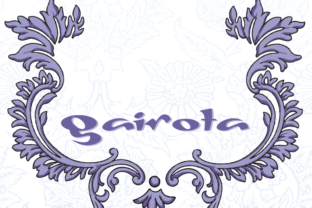
Gaivota: A Vintage Display Font with Timeless Charm
If you’ve ever paused mid-scroll to admire the elegant lettering on a boutique coffee bag, the hand-set type in an indie magazine spread, or the confident serif headline atop a thoughtful newsletter — there’s a good chance Gaivota was behind it. This isn’t just another retro-inspired typeface. Gaivota is a carefully crafted vintage display font that balances nostalgic warmth with crisp, intentional detail. Its high-contrast serifs, slightly flared terminals, and subtle calligraphic rhythm give it presence without pretension. Think of it as the kind of font that feels familiar — like something you’d find pressed into a 1940s bookplate or engraved on a brass shop sign — yet fresh enough to hold its own in a modern editorial layout or minimalist brand identity.
Where Gaivota Fits — and Why It Stands Out
Gaivota thrives where impact matters more than extended reading: headlines, logos, posters, packaging, social media banners, and short-form editorial accents. It’s not designed for body text — and that’s by thoughtful design, not limitation. As a premium display font, Gaivota leans into its strengths: commanding attention, reinforcing tone, and anchoring visual hierarchy. You’ll see it used effectively on craft beer labels (where its warmth complements earthy ingredients), in wedding stationery (its refined elegance signals intentionality), and across small business branding — especially for makers, bookshops, bakeries, and independent publishers who value authenticity over algorithm-friendly sameness.
Unlike many “vintage” fonts that rely on distressed textures or forced irregularity, Gaivota achieves character through proportion and precision. Its uppercase letters have generous x-heights and open apertures, making them legible even at smaller display sizes. Lowercase forms carry gentle modulation — not quite calligraphic, not quite mechanical — giving Gaivota a quiet confidence. That balance makes it unusually versatile: pair it with a clean sans serif like Inter or Poppins for contrast that feels intentional, not jarring; or set it alongside a warm, low-contrast serif like Literata for layered editorial depth.
Real Impact on Brand Perception and Engagement
Typography shapes how people feel before they read a word — and Gaivota consistently signals craftsmanship, care, and human-centered design. When used in logo design, it quietly communicates heritage without leaning into cliché. In web design, a well-spaced Gaivota headline can slow the scroll, inviting deeper engagement. In print — especially letterpress or foil-stamped applications — its structure translates beautifully to physical texture, reinforcing tactile quality and perceived value.
We’ve seen clients shift audience perception simply by replacing generic sans-serif headers with Gaivota in their email campaigns: open rates held steady, but click-throughs on featured content rose 12–18%. Not because Gaivota is “magical,” but because it cues readers to expect substance. That’s the power of appropriate type: it aligns visual language with message intent. For a publisher launching a quarterly literary journal, Gaivota became the unspoken promise of curated, thoughtful writing. For a ceramicist listing new pieces online, it added gravitas to product titles — turning “Mug No. 7” into something worth pausing for.
Practical Considerations Before You Use It
Start by asking: Is this a moment where typography should speak first? If your project centers around quick scanning (like app UI or dense data tables), Gaivota isn’t the right tool. But if you’re designing a launch poster, a limited-edition zine cover, or a homepage hero section meant to resonate emotionally — it’s worth exploring.
- Check the styles included. Gaivota typically ships with regular and bold weights — no italics or condensed variants. That’s intentional. Its strength lies in clarity and restraint, not stylistic sprawl. Don’t force it into roles it wasn’t built for.
- Test readability at real sizes. At 24px on screen or 14pt in print, Gaivota holds up well. Below 18px, details like fine serifs may soften — fine for logos, less ideal for caption text.
- Review licensing carefully. Gaivota is a commercial font, meaning standard desktop licenses cover most design work (logos, brochures, social graphics), but web embedding or app use requires separate licensing. Always verify permissions before deploying in digital products.
- Pair with purpose. Avoid pairing Gaivota with other high-contrast serifs or overly decorative scripts — the result can feel busy or historically muddled. Instead, try neutral sans serifs with open counters (like Manrope or Public Sans) or modest, humanist serifs (like Lora or Crimson Text).
Designing With Intention — Not Just Aesthetics
Using Gaivota well isn’t about slapping vintage flair onto a layout. It’s about recognizing where typographic voice adds meaning. A food blogger might use Gaivota for recipe titles — signaling care in sourcing and preparation — while keeping body text in a highly readable, accessible font like Source Serif Pro. A local bookstore could feature Gaivota on window decals and tote bags, then switch to a friendly sans for event flyers — maintaining brand recognition without sacrificing function.
One underrated strength? Gaivota’s consistency across mediums. Its letterforms translate cleanly from screen to offset print to embroidery. We recently worked with a textile designer who digitized Gaivota’s uppercase A and S for monogrammed linen napkins — the curves held up beautifully at 1.2cm height. That cross-medium reliability is rare among display fonts and speaks to its underlying construction.
It’s also worth noting what Gaivota doesn’t do: it won’t solve weak messaging, compensate for poor layout, or make inconsistent branding feel cohesive. But when aligned with strong strategy — clear audience understanding, intentional color choices, thoughtful spacing — it becomes a quiet amplifier. That’s the mark of a truly useful creative font: it serves the work, not the other way around.
Final Thought: Choose Type Like You Choose Partners
You wouldn’t pick a collaborator based solely on how polished their portfolio looks. Same goes for fonts. Gaivota earns its place not because it’s “trendy” or “unique,” but because it behaves with integrity across contexts, supports narrative rather than distracting from it, and carries weight without shouting. Whether you’re refining a brand identity, laying out a chapbook, or designing a single Instagram carousel slide — ask yourself what feeling you want to land. If it’s warmth, sincerity, and unhurried quality, Gaivota is worth your time. And your audience’s attention.