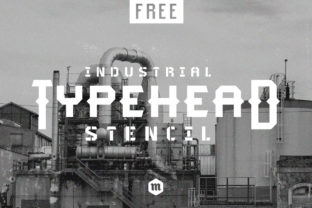
Typehead Family: Industrial Clarity, Modern Impact
When your design needs to communicate strength without shouting, precision without coldness, and modernity with authenticity—Typehead Family delivers. It’s not just another font stack. It’s a purpose-built typographic system engineered for environments where visual authority and functional clarity matter most.
A Font Built for Substance, Not Just Style
Typehead Family is a tightly curated set of four complementary variations: Typehead Bold, Typehead Medium, Typehead Light, and Typehead Condensed. Each weight shares the same underlying structure—sharp terminals, consistent stroke contrast, and subtly squared curves—but each serves a distinct role in hierarchy and context. There’s no decorative flourish here; every detail exists to reinforce legibility, presence, and intention.
What sets Typehead apart isn’t just its industrial aesthetic—it’s how that aesthetic functions. The letterforms are optimized for both screen and print at medium-to-large sizes, with generous x-heights and open counters that hold up well even in lower-resolution environments or under ambient lighting. Kerning is tight but never cramped; spacing feels intentional, not arbitrary. That balance makes Typehead unusually versatile for a family so strongly characterized.
Where Industrial Meets Intentional Use
You’ll find Typehead Family working hardest where tone and trust converge: branding for hardware startups, editorial layouts for technical journals, signage systems for co-working spaces, and UI elements in B2B SaaS dashboards. Its robustness doesn’t mean it’s loud—it means it’s dependable. A product launch page using Typehead Bold for headlines and Typehead Light for body copy reads as confident, not aggressive. A workshop flyer printed on recycled kraft paper gains texture and credibility—not gimmickry—when set in Typehead Condensed for event details.
Educators building course materials for engineering or design students often choose Typehead Medium for slide decks. Why? Because it conveys competence without intimidation—and students subconsciously associate its clean geometry with structured thinking. Similarly, freelancers pitching to manufacturing clients or sustainability-focused brands report higher engagement when their proposals use Typehead consistently across headings, timelines, and value statements. It signals you understand their world before you’ve said a word.
Real-World Applications Across Contexts
- Branding & Identity: Typehead works exceptionally well as a primary display face paired with a neutral, highly legible text face (like Inter or Lato) for body copy. Its strong personality anchors the brand; the supporting font ensures readability stays uncompromised.
- Digital Interfaces: In dashboard headers, status labels, or CTA buttons, Typehead Bold adds visual weight without sacrificing scannability. Its condensed variant shines in navigation bars or data tables where horizontal space is limited but clarity is non-negotiable.
- Print & Packaging: On product labels, spec sheets, or trade show banners, Typehead holds ink well and scales predictably—even at 8 pt on a tiny component sticker. Its industrial roots translate directly into perceived durability and attention to craft.
- Educational Content: When illustrating process flows, safety protocols, or assembly instructions, Typehead’s clarity reduces cognitive load. Learners focus on *what* to do—not *how to read* what to do.
Why It Resonates With Professionals (Not Just Designers)
Here’s what users consistently tell us: Typehead Family saves time in decision-making. When you’re juggling client revisions, platform constraints, and tight deadlines, having a font that “just works” across contexts reduces back-and-forth. No need to test three alternatives for headline treatment. No last-minute swaps because the chosen font didn’t render cleanly on iOS Safari. Typehead’s consistency means fewer variables—and more confidence in execution.
It also supports inclusive communication. Its high legibility at smaller sizes benefits readers with mild visual impairments. The clear distinction between similar characters (like O vs 0, or I vs l) reduces ambiguity in technical documentation or code-related content—something developers and technical writers appreciate deeply.
Practical Considerations Before You Commit
Typehead Family excels at medium-to-large applications—but it’s not ideal for long-form body text below 16 pt. Its personality is strongest when given room to breathe. If your project relies heavily on paragraph-level readability (e.g., a blog with 2,000-word posts), use it for headings, pull quotes, and section dividers only—and pair it thoughtfully.
Licensing is straightforward: one purchase covers desktop, web, and app use for a single entity. There’s no per-page fee or tiered subscription. That simplicity matters to small studios, solopreneurs, and educators managing tight budgets. Just verify your intended usage falls within the standard license terms—especially if embedding in a publicly distributed mobile app or white-labeled software.
And while Typehead’s industrial character is its strength, it’s worth asking: does your audience associate “industrial” with reliability—or rigidity? A wellness brand pivoting toward holistic tech tools might find Typehead too assertive next to soft photography and warm color palettes. But that same brand launching a new line of durable, field-tested wearable sensors? Suddenly, Typehead becomes an authentic tonal match—not a stylistic compromise.
More Than a Typeface—A Communication Anchor
At its core, Typehead Family is about reducing friction between intent and perception. When you choose it, you’re not selecting a trend—you’re aligning your visual language with values like transparency, resilience, and thoughtful construction. That alignment shows up in how users perceive your message, how collaborators interpret your direction, and how stakeholders assess your attention to detail.
It’s used by urban planning consultancies labeling infrastructure maps, by indie game studios naming cyberpunk UI elements, by university labs documenting experimental protocols—and yes, by designers who simply want a font that behaves itself while still carrying weight. Its quiet confidence makes it easy to overlook… until you try replacing it. Then you notice how much harder other fonts work to achieve the same sense of grounded authority.
If your current type choices feel either too safe or too distracting—if your headlines compete with your message instead of clarifying it—Typehead Family offers a different path. One where strength is expressed through structure, not exaggeration; where modernity comes from restraint, not ornament; and where every variation earns its place in your toolkit.