Janetta Rossie Duo: A Thoughtful Font Pair for Purpose-Driven Design
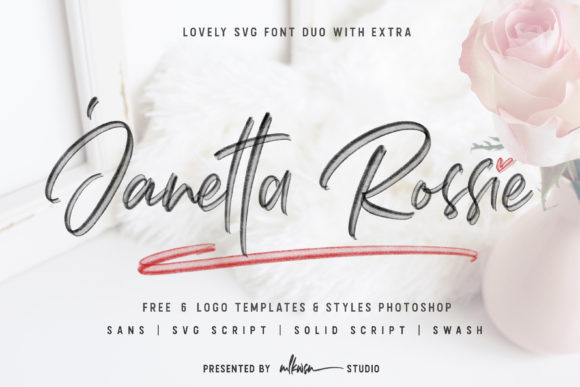
Janetta Rossie Duo stands out not because it shouts, but because it listens—carefully—to the needs of designers and brand builders who value intentionality over ornamentation. It’s a coordinated pair of typefaces: one a refined, slightly modulated script with natural rhythm and subtle contrast; the other a clean, warm sans serif with gentle curves and open apertures. Neither feels overly stylized nor generic. Instead, they occupy a balanced middle ground—distinct enough to create visual hierarchy, harmonious enough to feel like a single design decision.
What Makes This Duo Function Well Together
The pairing works because its contrast is deliberate and legible—not dramatic for drama’s sake. The script carries personality without sacrificing readability at medium sizes (14–24 pt), while the sans serif provides grounding, clarity, and scalability. Letterforms share proportional cues: similar x-heights, consistent stroke endings, and matching optical weight distribution. That means when used side by side in a logo or headline/subhead layout, alignment feels intuitive—not forced.
Unlike many script/sans combos that rely on extreme contrast (e.g., ultra-thin script + bold geometric sans), Janetta Rossie Duo avoids visual tension. Its script has modest thick-thin variation and generous spacing; its sans has soft terminals and moderate letterfit. As a result, the duo holds up well across formats: from small mobile screens to printed wedding stationery, and from social media banners to physical signage at 36 inches wide.
Practical Applications—and Where It Excels
Janetta Rossie Duo is especially effective where tone and trust matter. Think fashion labels aiming for quiet confidence rather than flashiness, wellness studios communicating calm competence, or boutique publishers crafting book covers that feel personal but polished. It’s also well-suited for wedding invitations—not as a clichéd “romantic” choice, but as a considered option for couples prioritizing elegance over extravagance.
In branding contexts, the duo supports clear visual storytelling. The script lends warmth and human presence; the sans delivers structure and accessibility. Used in combination, they can define voice without needing heavy illustration or color support. For example, a local ceramics studio might use the script for its name (“Clay & Hearth”) and the sans for tagline (“Hand-thrown in Portland”)—creating immediate recognition and tonal cohesion.
For digital use, both fonts include full Latin character sets, standard ligatures, and basic OpenType features (like discretionary ligatures and stylistic alternates). They render consistently across modern browsers and major design tools—including Figma, Adobe Creative Cloud, and Affinity apps. No webfont hosting complications or missing glyphs in common European languages.
Quality and Craftsmanship: What You’re Actually Getting
The outlines are smooth and precisely hinted. Kerning pairs are thoughtfully applied—not just for common combinations (AV, To, Wa), but for less obvious ones that appear in real copy (e.g., “flow,” “yours,” “studio”). There’s no visible wobble in curves or inconsistent stress angles—a frequent issue in lower-tier script fonts. The sans serif maintains even color and rhythm even at 10 pt in UI contexts, which speaks to careful spacing and vertical metrics.
Importantly, both fonts avoid over-engineering. There are no unnecessary swashes, no excessive alternate characters that clutter the glyph panel, and no forced “handwritten” imperfections that age poorly. That restraint contributes to longevity: a logo built with Janetta Rossie Duo today won’t look dated in three years simply because trends shifted away from “quirky” scripts.
Bonus Logo Templates: Useful—but Not a Substitute for Custom Work
The included six editable logo templates serve as practical starting points—not finished solutions. Each uses the duo intelligently: some stack the script above the sans for vertical balance; others integrate them into monograms or wordmarks with thoughtful negative space. All are delivered as layered vector files (SVG and AI) with editable text, colors, and spacing—no raster elements or locked layers.
They’re most helpful for small business owners launching quickly or freelancers building early-stage brand concepts for client review. But they shouldn’t replace custom typography work for established brands. Their value lies in speed and inspiration—not uniqueness. A savvy user treats them as springboards, then adjusts tracking, baseline alignment, or weight balance to match their specific mark.
Who Benefits Most—and When to Look Elsewhere
Janetta Rossie Duo fits best for professionals who need reliable typographic contrast without complexity: freelance designers building brand identities for lifestyle, creative, or service-based clients; educators designing course materials that balance approachability and authority; bloggers curating visually cohesive newsletters or digital zines; and small retailers developing packaging or Shopify storefronts where consistency across touchpoints matters.
It’s less ideal for high-contrast editorial layouts requiring aggressive typographic hierarchy (e.g., magazine spreads with tight columns and rapid scale shifts), or for tech startups leaning heavily into minimalist, system-driven aesthetics—where a more neutral, highly engineered sans serif might be preferable. Similarly, if your project demands extensive multilingual support beyond Western European languages (e.g., Cyrillic, Greek, or extended diacritics), verify coverage before committing—it includes robust Latin support but stops short of Pan-European or extended Unicode ranges.
Workflow Integration and Long-Term Usability
Installation is straightforward across macOS and Windows. Licensing allows commercial use—including client work—with no per-seat restrictions for individual users. Files are well-organized: OTF versions for desktop use, WOFF2 for web projects, and clear documentation on variable font options (though Janetta Rossie Duo itself is static, not variable).
Because both fonts are optically balanced and designed as a set, you avoid common pairing pitfalls—like mismatched cap heights, conflicting x-heights, or clashing stroke weights—that often require manual adjustment. That saves time during mockup phases and reduces revision cycles with clients unfamiliar with typography nuances.
Over time, its strength lies in adaptability. A brand identity built around Janetta Rossie Duo can evolve gracefully: swap the sans for a bolder weight in promotional campaigns, use the script alone for social media quotes, or apply the sans in app interfaces without losing continuity. It doesn’t demand constant reinterpretation—just thoughtful application.
A Final Note on Realistic Expectations
No font duo solves all design problems—and Janetta Rossie Duo doesn’t claim to. It won’t magically fix weak concept work, compensate for poor layout, or override mismatched color choices. Its value emerges when paired with sound design judgment: attention to spacing, hierarchy, context, and audience. Used deliberately, it supports clarity and warmth without distraction. Used carelessly—like stacking too many weights or forcing it into cramped spaces—it loses impact quickly.
If your work regularly involves balancing personality with professionalism—if you build identities that must feel both human and dependable—Janetta Rossie Duo earns consideration not as a trend, but as a tool with quiet, sustained utility.