Robotronica
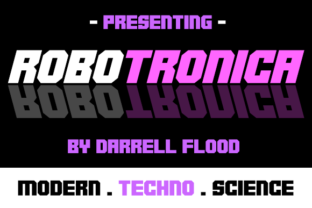
Robotronica isn’t just another sci-fi font—it’s a meticulously crafted typographic system designed to evoke the precision of robotics, the mystery of deep-space exploration, and the grit of interstellar conflict. Whether you’re designing a game interface for alien-world navigation, crafting a poster for a cyberpunk film festival, or branding a tech startup that builds autonomous field units, Robotronica delivers visual authority without sacrificing legibility. Its angular terminals, modular stroke weights, and subtle circuit-board-inspired detailing make it instantly recognizable—yet versatile enough to anchor serious design work, not just novelty graphics.
What People Often Misunderstand About Robotronica
Many assume Robotronica is purely decorative—a “futuristic” label applied loosely to any font with sharp edges or neon outlines. That misconception leads to poor implementation: using it for body text, overloading layouts with multiple robot-style fonts, or applying it without considering context. Robotronica was engineered for impact at medium-to-large sizes—not for paragraphs, captions, or UI microcopy. When used outside its intended scope, it weakens readability, dilutes brand clarity, and unintentionally signals amateurism rather than innovation.
Another common oversight? Treating Robotronica as a monolithic family. In reality, most legitimate versions include distinct weights (Light, Regular, Bold), optional extended glyphs (like hex-based numerals or control-panel symbols), and even companion sans-serif fonts for supporting text. Skipping this nuance means missing out on typographic hierarchy—and potentially paying for a basic version when your project needs variable-axis support or multilingual character sets.
Mistake 1: Downloading from unofficial sources
Free downloads of Robotronica often appear on aggregator sites promising “100% free sci-fi fonts.” But these files are frequently outdated, stripped of OpenType features, or—worse—embedded with malware or licensing traps. One designer unknowingly used a modified Robotronica file in a client’s app interface, only to receive a cease-and-desist letter months later. The font lacked proper commercial licensing and included hidden tracking code.
Better approach: Purchase or license Robotronica directly from the foundry’s official site or trusted platforms like Adobe Fonts, Fontspring, or MyFonts. Verify the license covers your use case—web embedding, mobile apps, merchandise, or SaaS dashboards—and check for updates. Reputable vendors also provide documentation, stylistic sets, and technical support.
Mistake 2: Ignoring optical scaling and spacing
Robotronica’s geometry looks crisp at 48pt on a banner—but collapses into visual noise at 14px on a mobile screen. Its tight letter-spacing and high contrast demand careful optical adjustment. Without kerning pairs optimized for headlines or tabular numerals for data panels, numbers like “1001” or “A7X” can appear uneven or misaligned, undermining credibility in technical or scientific contexts.
Better approach: Test Robotronica across real devices and sizes before finalizing layouts. Use CSS font-feature-settings where supported (e.g., "kern" 1, "liga" 1) and manually adjust tracking in design tools for critical headlines. For UI work, pair Robotronica with a highly legible, humanist sans (like Inter or IBM Plex Sans) for all non-headline text—never stretch or distort the font to “fit.”
Mistake 3: Assuming all “robot-style” fonts are interchangeable
Not every angular, geometric typeface qualifies as Robotronica—or serves the same purpose. Fonts like Orbitron, Exo, or Rajdhani share surface-level traits but differ significantly in x-height, ascender/descender ratios, and terminal treatment. Using Orbitron instead of Robotronica for a Mars rover mission dashboard may seem functionally similar—until engineers report difficulty distinguishing “O” from “0” or “l” from “1” under low-light simulation conditions.
Better approach: Compare glyph sets side-by-side, especially for characters critical to your domain: units (kPa, µm), codes (R-77, X9B), or symbols (±, ∆, Ω). Check how each font renders in grayscale and at 72dpi—many sci-fi fonts rely heavily on color or effects that vanish in print or accessibility modes. If accuracy matters, prioritize fonts with engineering-grade character coverage and tested WCAG-compliant contrast ratios.
What to Verify Before You Commit
Before licensing Robotronica—or any specialized display font—ask yourself three questions:
- Does the license explicitly allow my use case? A personal-use license won’t cover a Shopify store selling cyborg-themed apparel. An app license may exclude embedded PDF generation.
- Are the glyphs I need actually included? Check for Latin Extended-A, IPA, Greek, Cyrillic, or custom symbols if your project spans international markets or technical documentation.
- Is there active maintenance and support? Reputable designers update Robotronica for new OS rendering engines (like Apple’s Core Text improvements or Chrome’s HarfBuzz upgrades). Outdated versions may render poorly on newer devices or fail accessibility audits.
Also consider workflow integration. Does Robotronica support variable fonts? Can it be loaded efficiently via @font-face without bloating page weight? Some versions offer lightweight WOFF2 subsets—ideal for fast-loading web experiences—while others require full-family loading, slowing down performance-critical interfaces.
Using Robotronica With Purpose—Not Just Gimmick
The strongest applications of Robotronica treat it as a strategic tool—not a stylistic shortcut. A university’s astrobiology department uses it sparingly in lecture slide headers and lab signage, reinforcing thematic cohesion without overwhelming academic content. A VR game studio applies Robotronica only to in-world HUD elements and faction insignias, preserving immersion while ensuring players read mission-critical data at a glance.
That discipline pays off. Readers, users, and clients don’t remember “a cool robot font”—they remember clarity, consistency, and confidence. Robotronica earns its place when it supports intent, not distracts from it.
If you're evaluating Robotronica for an upcoming project, start small: test one weight in a real layout, measure load time and readability across devices, and get feedback from actual users—not just fellow designers. That grounded, iterative approach separates memorable sci-fi typography from forgettable visual noise.