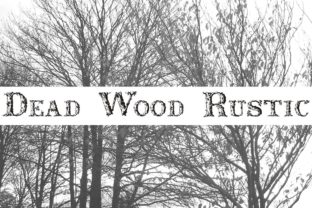
Dead Wood Rustic Font
Dead Wood Rustic is a decorative typeface that looks like it grew from the forest floor—rough, organic, and full of quiet character. It’s not polished or uniform. Instead, its letterforms echo gnarled branches, weathered bark, and split timber: uneven strokes, subtle tapering, asymmetrical curves, and intentional irregularities that mimic how wood ages naturally. This isn’t a font for body text or spreadsheets. It’s made for moments when you want your words to feel grounded, authentic, and quietly expressive.
Why Designers and Creators Reach for Dead Wood Rustic
People choose this font when they’re trying to communicate warmth, resilience, or handmade charm—not perfection. A small-batch soap label might use Dead Wood Rustic for its “Wild Lavender” variant because the letters look like they were carved by hand. A local coffee roaster could set their seasonal blend name in it on a chalkboard-style menu, reinforcing a story of origin, craft, and place. It works especially well when the goal is emotional resonance over efficiency.
Unlike sleek sans-serifs or elegant serifs, Dead Wood Rustic doesn’t try to disappear into the background. It invites attention—not with loudness, but with texture. That makes it valuable for anyone building a visual identity rooted in nature, sustainability, or artisanal values.
Where It Fits Naturally (and Where It Doesn’t)
Think of Dead Wood Rustic as a special ingredient—not an everyday staple. It shines in contexts where authenticity matters more than neutrality:
- Branding for eco-conscious businesses—farm stands, herbal apothecaries, reclaimed-wood furniture makers.
- Event design—wedding signage, rustic barn invitations, outdoor festival posters.
- Digital storytelling—blog headers for nature writers, Instagram quote graphics for mindfulness coaches, podcast cover art for forest therapy guides.
- Educational materials—classroom posters about botany or ecology, nature journal templates, homeschool lesson headers.
It’s less suited for long paragraphs, mobile app interfaces, or legal disclaimers—places where legibility, speed, and consistency are non-negotiable. Using it for a website’s navigation bar or a product spec sheet would likely create friction instead of connection.
Real-Life Uses You Can Try Today
If you’re just starting out, here are low-pressure ways to explore Dead Wood Rustic without overcommitting:
- Create a printable herb garden label. Type “Rosemary” or “Thyme” in Dead Wood Rustic, print on kraft paper, and attach it to a clay pot with twine.
- Design a simple social media post. Overlay a short nature quote—like “Rooted in stillness”—on a photo of misty woods. Keep the font size generous and the background uncluttered.
- Sketch a logo concept for a friend’s new hiking gear shop. Use Dead Wood Rustic for the shop name only—not the tagline—and pair it with a clean, readable sans-serif underneath.
These examples work because they respect the font’s strengths: presence, personality, and context-awareness. They also avoid asking it to do things it wasn’t designed for—like conveying urgency or technical precision.
What to Keep in Mind Before You Use It
Dead Wood Rustic is expressive—but expression needs intention. Here are practical things to consider before adding it to your project:
- Legibility at small sizes. Its natural irregularities soften edges, which means it can blur or merge below ~24pt in print or ~20px on screen. Always test it where it will actually appear—not just in your design app.
- Pairing matters deeply. It pairs beautifully with neutral, open fonts like Inter, Work Sans, or even classic Georgia—but clashes with other highly decorative or overly ornate typefaces. Think contrast, not competition.
- Licensing is essential. Some versions of Dead Wood Rustic are free for personal use only. If you’re using it for a client’s brand, an online course, or merchandise, check the license terms carefully. Commercial use often requires a one-time purchase or subscription.
- Not all file formats behave the same. The OTF version usually preserves its subtle weight shifts and alternate glyphs best. Web use (WOFF2) may require testing across browsers—especially Safari, which sometimes renders fine textures less crisply.
How It Supports Real Creative Goals
For educators making nature-themed worksheets, Dead Wood Rustic adds tactile warmth without distracting from learning objectives. For freelancers designing for wellness clients, it helps visually reinforce values like grounding and renewal. For small business owners launching a line of beeswax candles, it quietly tells customers, “This was made with care—not mass-produced.”
That’s the quiet power of this font: it supports meaning without shouting. It doesn’t replace strategy—it deepens it. When your message is about growth, patience, or returning to basics, the right typeface can echo that idea before a single word is read.
A Thoughtful First Step Forward
If you’re drawn to Dead Wood Rustic, start simple. Download a trial version or free personal-use variant. Open a blank document. Type one meaningful word—“Gather,” “Bloom,” “Hearth,” “Wander.” Resize it. Rotate it slightly. Place it against a soft neutral background or a muted photo of moss, stone, or sunlight through leaves.
Notice how it feels—not just how it looks. Does it settle comfortably into the space? Does it support the mood you want to create? There’s no wrong answer, only clearer intuition with each experiment.
Fonts like Dead Wood Rustic remind us that design isn’t just about communication—it’s about connection. And sometimes, the most resonant connections begin with something as humble as the curve of a branch, translated into letterform.