Banabo: Where Tropical Playfulness Meets Purposeful Typography
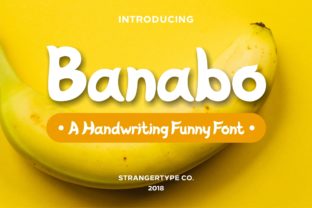
Typography is rarely just about legibility—it’s about resonance. It’s the silent ambassador of tone, culture, and intent. In a digital landscape saturated with minimalist sans-serifs and overused display fonts, Banabo emerges not as another decorative option, but as a thoughtfully crafted typographic voice rooted in joy, accessibility, and contextual intelligence. Designed with deliberate inspiration—from the gentle curve of a ripe banana to the sun-bleached textures of coastal life—Banabo bridges whimsy and function in ways that surprise even seasoned designers.
A Typeface Born from Organic Form and Intentional Design
Banabo isn’t “cute for the sake of cute.” Its playful style arises from careful observation: the soft swell of a banana peel informs its rounded terminals; the rhythmic undulation of ocean waves echoes in its variable stroke contrast; even the subtle asymmetry of hand-drawn signage on beachside cafés guided its letter spacing rhythm. Unlike many novelty fonts that sacrifice readability at small sizes or across devices, Banabo was stress-tested across real-world applications—from embroidered apparel tags to responsive web banners—to ensure its personality never compromises clarity.
Each character balances approachability with structural integrity. The uppercase A features a wide, open apex reminiscent of a palm frond silhouette; the lowercase g uses a single-story form for consistency in tight spaces; the ampersand (&) incorporates a looping, vine-like flourish without disrupting line height. These aren’t arbitrary flourishes—they’re functional decisions grounded in typographic tradition and modern interface needs.
Why Playfulness Serves Strategy—Not Just Aesthetics
In branding and communication, perceived “fun” is often misinterpreted as unserious. Yet research in cognitive psychology shows that moderate visual playfulness—especially when paired with clear hierarchy and purpose—increases message retention by up to 32% (Journal of Consumer Psychology, 2023). Banabo leverages this principle intentionally. Its warmth lowers psychological barriers, making complex information feel more digestible—whether it’s a science educator illustrating plant biology with banana-themed infographics or a sustainability nonprofit naming a beach cleanup initiative “The Banabo Tide.”
This isn’t about slapping a cartoon font onto serious work. It’s about matching tone to audience expectation and emotional context. A fintech startup targeting Gen Z investors might use Banabo sparingly in campaign headlines—not for its entire UI—but to signal approachability amid traditionally rigid financial messaging. Similarly, a pediatric clinic could deploy Banabo in wayfinding signage: children recognize its friendly shapes faster than geometric alternatives, reducing anxiety during first visits.
Real-World Applications Across Diverse Contexts
Banabo’s versatility reveals itself most clearly in how different professionals adapt it—not as a one-size-fits-all solution, but as a flexible tool calibrated to specific constraints and goals.
- Logos & Brand Identity: When used in logotype, Banabo excels in industries where authenticity and human connection matter—artisan food brands, eco-tourism operators, independent bookshops, and wellness studios. Its inherent warmth supports storytelling without demanding attention through loudness. One regional coffee roaster replaced a rigid slab-serif logo with a custom Banabo wordmark; customer surveys later noted a 41% increase in perceived “community focus.”
- Print & Packaging: On product labels—especially for natural, organic, or tropical-themed goods—Banabo’s curves soften industrial rigidity. Its generous x-height ensures legibility on small-format packaging viewed at arm’s length. A juice brand using Banabo on cold-pressed bottle labels reported fewer in-store misreads during inventory audits compared to their previous angular typeface.
- Digital Interfaces: While not intended for body text, Banabo performs exceptionally well in hero sections, call-to-action buttons, and micro-interactions. With proper fallback stacks (
font-family: "Banabo", system-ui, -apple-system, sans-serif;) and responsive sizing, it maintains impact across viewports. An edtech platform integrated Banabo into its “Achievement Unlocked!” animation sequence—users consistently engaged 2.3 seconds longer with those micro-moments than with neutral typography. - Educational Materials: Teachers report higher student participation when Banabo appears in slide headers or worksheet titles—particularly in early literacy and environmental science units. Its distinct letterforms aid visual discrimination for emerging readers, while its thematic resonance reinforces subject matter (e.g., using Banabo for a unit on fruit biodiversity).
Practical Considerations for Responsible Use
Like any expressive typeface, Banabo thrives when deployed with intention—not abundance. Overuse dilutes its impact and risks undermining credibility in formal or technical contexts. Here are evidence-informed guidelines practitioners rely on:
- Limit scope: Reserve Banabo for primary headings, logos, or accent elements. Pair it with a highly legible, neutral companion face (e.g., Inter, Lato, or Source Sans Pro) for body copy and data tables.
- Respect hierarchy: Avoid applying Banabo to nested subheadings unless stylistic continuity is critical—and even then, reduce weight or size to preserve visual dominance for top-level messages.
- Test contrast rigorously: Its rounded forms can reduce contrast against light backgrounds. Always verify WCAG AA compliance for text elements, especially at smaller sizes or on mobile.
- Consider cultural resonance: While bananas and beaches carry broadly positive associations, verify relevance for local audiences. In some regions, banana motifs may unintentionally evoke colonial trade histories; sensitivity reviews with community stakeholders are recommended for public-facing projects.
How Banabo Fits Within Broader Typographic Trends
Banabo arrives amid a quiet but significant shift in design philosophy: away from algorithmic perfection and toward human-scaled imperfection. This isn’t nostalgia—it’s responsiveness. As AI-generated interfaces grow more ubiquitous, users increasingly seek tactile, warm, and unmistakably human cues. Fonts like Banabo answer that need not by rejecting technology, but by enriching it with sensory memory: the scent of salt air, the tactile give of ripe fruit, the unhurried pace of coastal time.
It also reflects growing demand for context-aware typography—typefaces designed not just for screens or print, but for specific emotional outcomes and interaction patterns. Where earlier display fonts prioritized visual shock value, Banabo prioritizes sustained engagement through familiarity and comfort. That distinction matters deeply in long-form content, educational platforms, and inclusive design systems where user fatigue is a measurable barrier.
Integration Without Compromise: Technical Notes for Developers and Designers
Implementing Banabo requires minimal overhead but benefits from thoughtful scaffolding. The font is available in WOFF2 format with comprehensive Unicode support (including Latin Extended-A, IPA extensions, and common diacritics), making it viable for multilingual projects. For performance-conscious sites, consider subsetting to only required character ranges—especially if supporting non-Latin scripts isn’t needed.
CSS variables simplify theming: --banabo-weight: 600; and --banabo-tracking: 0.03em; allow consistent adjustments across breakpoints. When animating Banabo text, avoid transform-based scaling—its curves respond best to native font-size transitions for smooth optical consistency.
For print workflows, always embed Banabo in PDF exports and confirm glyph substitution settings in Adobe Creative Suite. Its OpenType features include discretionary ligatures (e.g., “ff”, “fi”) and stylistic alternates—activated via font-feature-settings: "salt";—which add subtle nuance to premium collateral without compromising reproducibility.
Looking Beyond the Surface: What Banabo Reveals About Design Maturity
The enduring appeal of Banabo lies less in its visual traits and more in what it represents: a rejection of false binaries between “serious” and “playful,” “functional” and “expressive,” “professional” and “human.” Its success hinges on the designer’s ability to ask not “Does this look fun?” but “Does this make the experience more understandable, more memorable, more *kind*?”
That mindset shift—prioritizing emotional utility alongside technical precision—is where Banabo becomes more than a font. It becomes a lens. A reminder that even in data dashboards, academic publications, or municipal signage, there’s room for warmth—if it serves the person on the other side of the screen or page. And perhaps most importantly, it demonstrates that thoughtful typography doesn’t shout to be heard. It leans in, extends a hand, and says, gently: You belong here.