Aged Machine Font
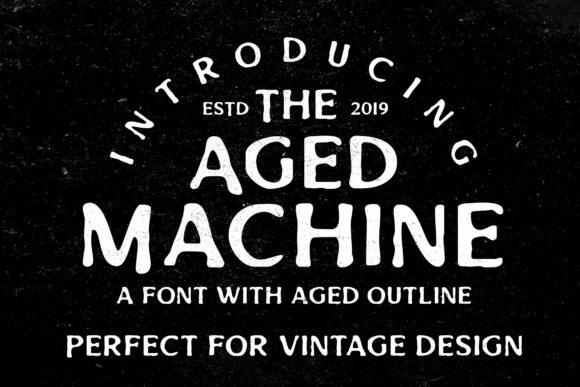
Aged Machine is a display typeface designed to evoke the visual texture and character of mid-20th-century industrial printing—think weathered metal letterpress plates, typewriter ribbons worn thin by repeated use, or stenciled signage exposed to decades of sun and rain. It is not a revival of a historical font, nor a digitized scan of vintage source material; rather, it is a carefully crafted original design that simulates age intentionally, using subtle irregularities in stroke weight, uneven baseline alignment, slight ink bleed effects, and intentional imperfections like chipped edges and faded contrast. These features are built into the outlines—not applied as layer effects—making Aged Machine function reliably across platforms and output methods when used appropriately.
Designers and brands often seek fonts like Aged Machine when authenticity, tactile presence, or nostalgic resonance matters more than pristine uniformity. Its appeal lies not in neutrality but in specificity: it signals craftsmanship, history, and intentionality. That makes it especially relevant for projects where visual tone carries narrative weight—such as album artwork for indie folk or garage rock bands, limited-edition apparel labels, artisanal food packaging, or event posters for retro-themed festivals.
When Aged Machine Fits Well
Aged Machine performs best in controlled, high-impact applications. It excels at sizes above 36 pt—especially in large-format print (posters, signage, wall graphics) and digital displays with sufficient resolution (hero banners, social media cover images). Its texture becomes legible and expressive at scale, where individual quirks read as character rather than noise.
Brands with a deliberate vintage positioning—particularly those rooted in analog culture, craftsmanship, or regional heritage—often find Aged Machine aligns well with their voice. Clothing lines emphasizing handmade production, record labels releasing vinyl reissues, or cafés built around mid-century design principles may use it effectively in logos or wordmarks, provided it’s paired with a neutral, highly legible companion font for body text and functional elements.
The font includes standard Latin characters, numerals, and basic punctuation. It supports OpenType features such as stylistic alternates and ligatures, which allow users to fine-tune visual rhythm—for example, swapping in a slightly more eroded “A” or adjusting spacing between certain letter pairs. These options support thoughtful typographic hierarchy without requiring manual vector edits.
Limitations and Practical Considerations
Legibility is the primary tradeoff. At small sizes—below 24 pt in print or under 20 px on screen—the irregularities that define Aged Machine begin to interfere with character recognition. Letters like “e,” “c,” and “a” can blur together; similar forms (“o” and “e,” “I” and “l”) may become ambiguous in dense settings. It is unsuitable for long-form text, data tables, UI labels, or any context demanding rapid scanning or accessibility compliance (e.g., WCAG AA contrast and clarity thresholds).
Another consideration is licensing scope. Aged Machine is typically distributed under desktop and web font licenses with clear usage boundaries. Web use requires proper @font-face implementation and attention to file size—its variable weight and alternate glyphs increase payload. Projects with strict performance budgets (e.g., high-traffic marketing sites or embedded kiosk interfaces) may need to weigh whether its aesthetic benefit justifies the technical overhead.
Cross-platform rendering also varies. While modern browsers handle its OpenType features robustly, older Android versions or legacy email clients may fall back to system fonts or render glyphs inconsistently. Testing across target environments remains essential—not because the font is unstable, but because its design relies on precise glyph behavior.
When to Consider Alternatives
If your project prioritizes versatility over distinctiveness, alternatives merit evaluation. For example, Chivo or Work Sans offer subtle humanist warmth with full language support, responsive scaling, and strong accessibility profiles—ideal for brand systems needing both a headline voice and functional text layer. Similarly, IBM Plex Sans provides monospaced and proportional variants with rigorous testing across platforms and use cases, making it a pragmatic choice for tech-adjacent or institutional work.
For vintage-inspired projects where Aged Machine feels too extreme, softer options exist. Fonts like Playfair Display (with its transitional serif elegance) or Proza Libre (a warm, open-source sans with gentle irregularity) deliver period suggestion without sacrificing readability. These maintain visual interest while remaining adaptable across headings, captions, and interface text.
Crucially, the decision isn’t only about aesthetics—it’s about workflow integration. If your team lacks typography expertise or relies heavily on automated design tools (e.g., CMS-driven templates or no-code builders), a highly stylized font like Aged Machine may introduce friction. Its strength lies in deliberate, hands-on application—not plug-and-play deployment.
Making an Informed Choice
To determine whether Aged Machine suits your needs, ask three questions:
- What is the primary communication goal? If conveying timelessness, authenticity, or tactile craft is central—and if your audience expects or responds to that tone—Aged Machine can reinforce that message meaningfully.
- Where and how will it be used? Map each intended application: logo (static, scalable), web headlines (responsive, performant), apparel prints (screen-printed, fabric-dependent), or motion graphics (frame-rate sensitive). Eliminate uses where legibility or technical constraints outweigh expressive value.
- What resources support its use? Do you have access to a designer who understands typographic pairing and hierarchy? Can you test rendering across devices and outputs? Is licensing aligned with your distribution channels (e.g., SaaS platform vs. physical product)?
Testing is non-negotiable. Download a trial version and set real copy—not placeholder text—in actual layouts. Print samples at intended sizes. View them on mobile and desktop screens under varied lighting. Compare side-by-side with alternatives at the same scale and weight. Observe how it behaves in context—not in isolation.
Finally, remember that typography serves content—not the reverse. Aged Machine is a tool with clear strengths and defined limits. Its value emerges not from novelty, but from fit: when its texture echoes the substance of what it sets, it deepens understanding. When misapplied, it distracts—or worse, obscures. Choosing it thoughtfully means honoring both its character and its constraints.